Saturday, August 12, 2006

Intertainment requires patience

In the spirit of our President, I've decided to take a vacation from substantive blogging. So now, for something completely different. Thanks to www.break.com for the videos.


In reality, this is a mix of two videos. The full video of the screaming German kid, with translated subtitles for context, is below. His parents must have a tranquilizer gun in every room of the house. And you thought only American children were overweight, impatient pygmies? Listen to this child wheeze...


Finally, tip of the hat to Steven Colbert who, in reacting to a dig from Bill O'Reilly and Geraldo, called the two of them, "itty-bitty Nixons, without the relevance or a hint or vision." Bravo.

Thursday, July 27, 2006

Is an Israeli teardrop worth more than a drop of Lebanese blood?

Among other things, I've spent the last few weeks researching the roots of the Israel's current war of aggression against Lebanon. I even drafted an essay on the history of Lebanon for the modern-day alarmist, which you can read here. As for the current state of Lebanon's politics, that can be quickly summarized in two points: first Lebanon's Constitution requires a Christian (Maronite) President, a Sunni Muslim Prime Minister and a Shi'a Muslim Speaker of the Parliament, and second, read this piece on how the Christian enclaves of Beirut are unscathed, untargeted and, quite uninterested by Israel's constant bombardment of their fellow Muslim citizens.

In drafting this essay, I initially set out to lay down a comprehensive history of the Middle East from World War I to the present day. You see, there really was no Middle East until England and France carved up the region pursuant to the Sykes-Picot Agreement, despite their later pledge of "the complete and total liberation" of Arab peoples in the Anglo-French Declaration. Moreover, I was going to detail the backroom deal in which England secretly ceded a portion of their Mandate of Palestine for the establishment of a Jewish state through the Balfour Declaration of 1917, which was later consummated in the scandalous 1947 UN Partition of Palestine. Richard Cohen recently was lambasted for, in my opinion, an insightful, honest article describing that scandal. I was also going to explain to you how corporate avarice has, and continues to, destabilize the Middle East as oil was first privatized, then nationalized, and is now being privatized again. (As a sidenote, if you have a second, read about St. John Philby, who was a key to the privatization process and, in my opinion, one of contemporary history's most incredible, yet largely unknown figures.) I was even going to tell you how Britain, after establishing dominance over Iraq and its oil in the 1920s, fought an Iraqi insurgency by outsourcing the fighting to Indian soldiers. Ultimately, however, I've decided to skip all that and publish only a solitary quote -- believing it to illuminate the single most important aspect of Israel's invasion. However, in editing for publication, my rage percolated and I just had to do a few paragraphs on Bush. But first, the quote.

Yesterday, Prime Minister (Sunni) Fouad Siniora of Lebanon queried, rhetorically, the American body politic: "Is the value of human life less in Lebanon than that of citizens elsewhere? Are we children of a lesser God? Is an Israeli teardrop worth more than a drop of Lebanese blood?" As of today, non-combatant (civilian) casualties stemming from Israel's response to the kidnapping of 3 of its soldiers number between 300 and 600 Lebanese and at least 150 Palestinians. 19 Israeli civilians have been killed.

Meanwhile, the Bush administration, which speaks on the international stage for you, me and every other American, has turned a deaf ear to this suffering, all the while tirelessly marketing undocumented allegations that Hezbollah, the Islamic revolutionary political faction in Lebanon, is currently being supported by Syria, Iran and, now, laughably, Al-Qaeda-- the ultimate hobgoblin in the Bush arsenal.

As to the allegation that Iran is currently funding and controlling Hezbollah, whether through its alleged surrogate Syria or otherwise, I challenge any reader to find documentation of this connection. I've found nothing in two weeks of searching. I did come to understand, through this excellent piece by Daniel Byman on the history of the relationship between Hezbollah, Syria and Iran, that Iran supported a nascent Hezbollah in the 1980s, as the group sought an Islamic revolution in Lebanon similar to that in Iran in 1979. However, Byman concedes that "Hezbollah is increasingly growing out of its role as a proxy and becoming more of a partner with both Tehran and Damascus." Moreover, he never once makes the assertion that Iran or Syria had any role in directing or approving the recent kidnapping of the two Israeli soldiers by Hezbollah.

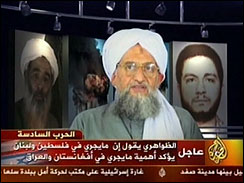
The last bit, the alleged Al-Qaeda connection, came out earlier today. It's being reported that Ayman al-Zawahiri, the alleged second in command to bin Laden, released a videotaped statement which included this gem: "The war with Israel does not depend on ceasefires. It is a Jihad for the sake of God and will last until (our) religion prevails ... from Spain to Iraq."

If you'll remember, Zawahiri is supposed to be bin Laden's attending doctor, living with him and the rest of those nefarious Al-Qaeda thugs while plotting evildoer-like things from some cave in the enigmatic "mountainous Afghan-Pakistani border region." I saw this interview on my favorite daily news program, The Newshour with Jim Lehrer, and was absolutely shocked. Not because of anything he was saying, as I'm more likely to believe this guy that Zawahiri is merely a pawn from CIA central casting, but rather at what I saw. Take a look for yourself at the picture below and ask yourself-- does anything seem out of place?


In case you missed it look again... and then slap yourself silly for not noticing that this guy, who we are told is running for his life in the nether-regions of Afghanistan, is in a television studio, complete with large scale prints of spooky images and multiple, dynamic lighting sources. Either Al-Qaeda's built a really nice studio and franchised a Kinko's nearby (which should make them pretty easy to find), or something is fishy here.

As of tonight, CBS is the only news source that even mentions the "professional television studio." However, CBS chief foreign correspondent Lara Logan completely missed the clue, instead remarking that, "It's a slicker look for al Qaeda's number two, who delivered his latest video message from what appears to be a professional television studio, complete with background props." [Update: This morning the New York Daily News, which masquerades as a newspaper but shares more in common with The National Enquirer, attempts to clarify the mystery by noting that "Zawahiri appeared in a white turban in front of photos of the World Trade Center towers burning, slain Al Qaeda military chief Mohammed Atef and a bearded 9/11 cell leader Mohamed Atta. Atta's photo was downloaded from a Zacarias Moussaoui trial exhibits Web site, while the phony backdrop was intended to look like Zawahiri was in a huge TV studio." That's it... no explanation why Zawahiri would "intend" to look like he was in a TV studio, or how he's getting the equipment necessary for such a production. But I guess that's just journalism today... a whole lot of "what," just no "why."]

Despite the distractions created by the allegations of foreign involvement and the potential of the Israeli aggression to incite a regional war, the mind of every concerned citizen of the world should focus on answering Prime Minister Siniora's question: "Is an Israeli teardrop worth more than a drop of Lebanese blood?"

Tuesday, July 11, 2006

The Republican Philosophy for the Economy: Entering the Alamo?

On June 18, I wrote on the woeful state of the American consumer. Updating that post, I offer the recent numbers from the Federal Reserve indicating that the negative trends cited in my post continue. To wit, consumer credit increased for the seventh consecutive month, a rise of $4.4 billion in May (a 2.4% increase) to a total of $2.17 trillion, spurred by a 9.9 percent gain in non-revolving credit (mostly credit cards) that amounted to an increase of $6.7 billion for the month. Meanwhile, Americans continue to eschew disposable savings, with the personal savings rate furthering its march into negative territory with a -1.7% reading. Simply put, this means that Americans are spending (actually borrowing) 1.7% more than they are earning. Here's a 2006 chart from the St. Louis Federal Reserve illustrating the personal savings rate over the last ten years-- notice any trend?

Since my first post, I've had some pretty smart people tell me that the personal savings rate calculation is misleading in that it does not include money squirreled away in retirement savings (401(k), IRAs, etc.) My retort is that those monies are not liquid-- you cannot access those dollars without penalty in most cases and, even if Americans did, I cannot find much positive in people sapping their retirement savings to pay their credit card bills and mortgages. As to mortgages, homeowners are now using a record percentage (11.4%) of disposable personal income to pay their mortgage obligations.

Ultimately, my point in setting forth these figures is to reflect on the effects stemming from a continuing negative personal savings rate and inevitable washing out of the credit pool, in sequence, leading to a decline in every material economic indicator other than the unemployment and tax rates. To the extent that you believe such a scenario is a bit too nihilistic, you're probably right-- the American consumer, as a class, will survive; albeit paying higher monthly interest charges and, perhaps, draining their savings. Whatever the next point in the cycle though, I would challenge anyone to exhibit an American economic model in which debt-laden consumers continue to spend and borrow in an environment where domestic interest rates are increasing and the world community is tortured by widening political and religious conflict.
Given these delicate economic conditions, it seems odd Republicans are laying the foundation for their mid-term election platform that includes a plank extolling their stewardship of the American economy. While corporations continue to report double-digit returns, the Republican government's greatest economic achievement is celebrating a deficit of $300 billion as a supply-side lesson in practice. Fortunately, not many are fooled. There is, however, at least one idiot arguing that the "White House can now very credibly assert that the deficit will indeed have been halved by the time Bush leaves office." Halved from what? The total deficit equals $1.4 trillion (with actual Congressional deficit spending of $2.2 trillion during the Bush administration) and "cutting that in half" can only be done by producing a surplus of $700 billion. However, as the Washington Post notes, even the administration's recent "midsession review" predicts that "spending will outstrip revenue in every year through 2011 -- the end of the administration's budget window. The administration notes that tax revenue this year is projected to be 18.3 percent of the nation's economic output, just above the 40-year average of 18.2 percent. It is projected to be under that -- averaging 17.9 percent -- from 2007 through 2011." If Republican-controlled Congressional spending continues (and likely increases) in this fashion and the domestic economy suffers from the aforementioned maladies of the American consumer, then "staying the course" with current domestic economic policy is indeed taking the American people into the Alamo: destined for defeat.
As the sun rises on tomorrow's America, we are virtually guaranteed to have a growing deficit, likely to have rising interest rates and metaphysically certain to have a decrease in the aggregate purchasing power of the American consumer. Pile on the ever-increasing rise in the price of crude oil, catalyzed by global turmoil (Gaza, Lebanon, Somalia, Iraq, Iran, North Korea, Afghanistan-- to name a few) and the continuing outsourcing/offshoring of domestic jobs, and it is difficult to imagine a great American economic renaissance anytime in the near future. After the last five years, it seems difficult to imagine a globalized economy prospering in these difficult conditions at any point in the near future, and that does not augur well for the American economy or its globalized supply chains. Maybe alternative energy production is the answer.
If you have a slice of the good life now, I'd recommend that you put part of it in the freezer. It may not taste as good ten years from now, but it'll be better than waiting in line for a slice, or having no slice at all.

Your comments are both welcome and encouraged.

Saturday, July 01, 2006

Laundry: Andy Rooney style

I was recently told, second-hand, that "all smart people watch 60 minutes." Fortunately, I have been watching the show and, in particular, the Andy Rooney segments. I have a great admiration for the sophisticated simplicity of his perspectively honest missives and curmudgeon's disposition. What follows is my best effort of describing a simple task I undertook today, channeling the Socratic Andy Rooney...

You see, I do all my laundry in a single, marathon session--a fashion that has suited me since I became responsible for my own laundry (thanks for those 18 years Mom). Seems more efficient to me to operate in this fashion, though I've noticed a difference in viewpoint with some, which surveys will tell us are primarily those of the opposite gender. The same survey reveals that men are four times more likely than women to find "spending time with their laundry partner the best part of doing laundry." However, "women can take solace in the fact that men are 3 times more likely to report that they stare at their laundry as it cycles."

Do you realize how much water your washer uses for a single load of laundry? In the United Sates, over 12 million gallons of water a day is used for laundry--that's nearly 4.4 billion gallons a year. And how does the washer work? Does it really clean my clothes? Would scrubbing my clothes get them any cleaner? What deficit in cleanliness am I willing to trade for modern convenience? What about the different brands of laundry detergent--is one better than the other? Turns outs that yes, some detergents are better at getting out certain types of stains. And dryer sheets/fabric softeners-- what are they made of? Whatever it is, they sure are handy.

Finally, I have a lesson to share with you. If you are doing your laundry in a marathon session like me, be sure to include the clothes you're wearing in the last load. There's nothing more disappointing than putting away all the laundry, only to realize that the clothes you're wearing are dirty.

Friday, June 30, 2006

Syntaxman: Please save ESPN's Jeff Brantley

In the spirit of the "Superman: The Movie I Probably Won't See," I offer a plea to Jor-L to birth a Syntaxman to save Baseball Tonight's Jeff Brantley, who emphatically remarked this evening with regard to the woes of the middle relief corps of the Cincinnati Reds:

"doesn't matter how well you starter does or how many runs you score, if you can't keep a team like Kansas City who can't score at all from scoring, in the middle of the ballgame, you got a problem."


Thanks Jeff... would have never guessed.

Wednesday, June 28, 2006

Iraq: Cut and Run or Stay and Bleed?

As you've likely heard, the issue du jour is whether to withdraw the troops from Iraq. Politicians eyeing the White House in '08 have each staked out a strategic peninsula, careful to look tough but not fence themselves in to any substantive policy that is either too radical or too conservative. Frankly, I wish the debate could move past the "cut and run" sloganeering and the vague pledges of Republicans to "stand down when the Iraqis can stand up." In my mind, and I'm sure in some of yours, the truth is that American troops will be in Iraq long after "W" is gone.

You see, we've only just begun in Iraq. Despite the laughable protestations of Republican hawks and Bush apologists that the invasion of Iraq was not about oil, we all know that it at least played a role in the decision to invade. That's the only aspect of the invasion I think was arguably justifiable. The oil that fuels the American economy is under Iraq, Iran, Saudi Arabia and, in smaller amounts, other countries in the Middle East. Iraq happened to be the easiest target, both politically and militarily. The US maintains a cozy economic relationship with Saudi Arabia, but domestic political pressures there forced the royals to boot the American military out of the country. Iran, while certainly scoring high on a political axis, scored very low on the military axis because it is a giant, rugged country with a military that has not suffered under draconian sanctions for the last decade. Iraq scored high on the military axis and, given a little selective use of intelligence information and some fear mongering, became a "slam dunk" on the political axis.

Once we had conquered the Iraqi military and gained control over the country's oil fields, Haliburton set about building a sprawling, high-technology fortress that will act as the American embassy in Iraq. American contracts have also been let to build large, seemingly permanent military air bases in both Iraq and Afghanistan. Is it conceivable that we would pay for all of this improvement to infrastructure, built to American specification, and then abandon it a few years later? It simply would not make sense-- even to the freewheeling spenders in the Bush administration.

Moreover, both Iraq and Afghanistan act as extraordinarily important strategic location for combating (figuratively, for now) the growing influence of both India and China. By having substantial air and ground resources stationed in Iraq and Afghanistan, the United States has implicit leverage in the regional politics of Southern Eurasia, with nations like Syria, Iran and what, if anything, might be left of Palestine bending under the yoke of American influence and threat of direct military intervention.
Also, recent history teaches us that American troops shouldn't leave Iraq or Afghanistan. It wasn't long ago that we funded both Saddam (against Iran) and the Afghan Mujihadeen in their battle against the Soviet invaders. In each of those instances, the forces we armed were subsequently used against us. Despite the nearly continuous stream of mistakes, disappointments and outright stupidity that emanates from the Bush White House, I firmly believe that they would not be dumb enough to rebuild infrastructure and rearm local security forces in Iraq and Afghanistan and then leave those resource-rich nations with no military to protect the newly acquired American interests.

These are the facts as I see them. As alluded to in the opening paragraph, I wish that these facts could be acknowledged and for the debate to mature from sound bites to policymaking. The policy question is simple: does the United States need control of the oil in these regions to maintain its place as a world superpower? In the short term, that answer is clearly yes. In the long term, however, oil is a non-renewable resource and one day, sooner or later, it will run out. Every country will be faced with an uncertain future and the potentially catastrophic consequences of an industrialized world economy that suddenly runs out of fuel.

If the United States wishes to maintain its influence over world affairs, it must address this eventual crisis with a thoughtful and long-ranging solution. Getting in front of the parade on a new source of energy (whether solar, hydrogen, wind or nuclear), putting substantial resources behind that solution and acting as the lead manufacturer of the fuel, byproducts and services is the only way the United States can maintain its standing as a first-world country in an oil-deprived world.

So, should we withdraw the troops? Absolutely; but just not now. For now, we must stay and bleed, both personally with our troops and financially with our wallets. The only palatable cut and run scenario is to withdraw after adopting a bipartisan energy policy that promotes the vast and rapid development of new sources of energy. Ergo, if you really want to support the troops then support the American creation and production of alternative energy sources and, please, support it now.

Sunday, June 18, 2006

The American Consumer: A Real Weapon of Mass Destruction

Whilst the debate gets underway on whether you support the troops, the mission, or both the troops and the mission, I'm hoping that someone will address an immediate threat to our future: the sorry state and perilous path of the American consumer.
Articles citing disturbing short-term trends in the economy are aplenty and many speculate on an impending recession spurred by declining asset prices, yet there is very little commentary from politicians or the daily media on how the economy will be affected by the current (and worsening) state of the debt-laden American consumer. As explained below, a continuing deterioration in the short-term health of the American consumer will dramatically affect the economy. In the long-term, a significant decrease in the borrowing and spending by American consumers may either induce or further accelerate a recession or perhaps depression.
To begin with, we must first understand the significance of the American consumer to the American economy. Approximately two-thirds of all economic activity in the United States is undertaken by the individual consumer-- you, me and the three hundred million other Americans. As a unit, we are the single fiercest economic force this plant has ever seen. However, as discussed below, our purchasing power has been waning and our debts have been mounting. Still, the American consumer forges on, emboldened by the incessant siren's song streaming from every imaginable commercial concern.
"The More You Buy, the More You Save!"
I heard that bit of American commercial wisdom in a radio advertisement. Probably wouldn't have worked quite as well on television-- can you imagine the facial contortions necessary to turn that phrase? The more I buy, the more I save? Does that also mean the less I buy, the less I save? What if I don't buy anything? I don't save anything?
What's plainly clear to me is that if I don't buy anything, I save what I already possess. However simple it seems to comprehend, the logic of that formulation seems to be lost on many Americans. How warped our little minds must be to equate saving with consuming. However, Americans as a whole are doing exactly that: spending more than we are saving (if we are saving at all). It's been widely reported that in June 2005 the Bureau of Labor Statistics issued a report indicating the personal savings rate (roughly the percentage of total dollars spent over total dollars earned) of Americans had become negative. This was the first time that the indicator had reached negative territory since the Great Depression, and it has remained negative for the last eleven months, dropping to its lowest level of -1.6% in April 2006, the most recent report released. The report for May will be released on June 30. Check back for an update. [Update: May personal savings rate: -1.7%]
While the declining personal savings rate is surely a cause for concern, the indicator will inevitably be corrected through the washing out of the credit pool. Those with the means will begin saving more as interest rates increase and the once-meteoric rise in asset prices continues to taper off. However, there will also be a significant number of defaults, foreclosures and bankruptcies. Consumers who are "leveraged 'till doomsday" will begin seeking those remedies in greater numbers as the Federal Reserve continues to raise the base interest rate to 5.25% and perhaps beyond. Oddly enough, total consumer credit in this country, estimated by the Federal Reserve to have currently reached a record $2.17 trillion, rose by 5.9% in April! [Update: The Fed said May's 2.4% increase in consumer credit followed a huge 5.2% rise in April. The slowdown occurred because of weakness in auto loans, which offset the jump in credit card borrowing. Borrowing on credit cards and other categories of revolving debt shot up at an annual rate of 9.9% in May, the biggest surge in this category since a 13.5% increase in October 2004.]
It's also estimated that American households on average carried $9,312 in credit card debt in 2004, the latest year for which statistics are available. Many of the rates for credit cards are keyed the rising base rate, and as the base right rises, so to will the APR on credit cards and adjustable rate mortgages (where default rates are rising dramatically). Given the recent "advances" in personal bankruptcy law, those Americans who do seek bankruptcy protection to prevent foreclosure will effectively be shut out of the financial system for at least the length of their repayment plan and likely longer. Debt slaves don't make good consumers.

Perhaps Bush and his "braintrust" could get something right and convince us that paying our credit card bills helps fight terrorism. However, given the deficit Bush has run up with the public's credit card, it's unlikely that even his whizbang team of spinners could put a shine on that pile. To the extent that consumers do begin to pull back their spending or consumer credit defaults, the Democrats would be wise to shift the debate to the sagging economy. While Democrats do not have a particularly shining economic record historically, they have never spent money as recklessly and partisan as the current administration, both domestically and internationally. As Bush and his cronies are so fond of saying, "9/11 changed everything." Apparently that includes Republicans, who appear to now support big government and a gross lack of fiscal discipline, including a national debt of $8.3 trillion.
Unfortunately, some "fool" is still arguing that old chestnut that deficits don't matter-- that's not the issue. The issue is that the deficit is growing unnecessarily in a time when the overall economy is stumbling and its main engine, the consumer, is drowning in an ocean of personal debt. In this environment, it is deplorable that the Bush administration is spending untold billions in its pseudowars and squandering billions more domestically with poor oversight while the Republican Congress approves outright pork projects.

Ultimately, for the personal savings rate to increase, the amount of money in the economic cycle must decrease. A decrease in the amount of capital circulating in the economy means a slowdown in economic activity and a concomitant decrease in production. If that slowdown in production lasts long enough, then you've seen a recession, and if it lasts longer, a depression. Commentators are just getting started on whether there will be a recession, though it is now clear that the likelihood of such an economic decline is no longer considered remote.

At a minimum, the writing is on the wall for at least a temporary pullback in consumer spending, which hopefully shows up in the personal savings rate report for May. The longer the indicator remains negative, the deeper the hole becomes and the longer the recession or depression will endure while consumers struggle under mountains of debt. A prolonged depression would also affect the increasingly global economy and may allow emerging powerhouses like China and India to capture further gains in global market share. The potential implosion of the American consumer is a real threat, and if that implosion occurs during a downturn in the business cycle, the economic effects would be similar to the detonation of a real weapon of mass destruction at Wall and Broad streets. Such an implosion would significantly depress or even eliminate growth in the American economy for the next several years.

Sunday, June 11, 2006

The Curse of Rocky Balboa

We've all heard of curses in the sports world. There used to be one that haunted the Boston Red Sox, but that curse was broken in 2004. Not to be outdone, the Cubs have their own curse, as do the St. Louis Cardinals (later broken in October 2006), anyone or anything touched by basketball legend Elgin Baylor and the entire city of Philadelphia, apparently suffering under an umbrella curse that affects all of their sports teams. Well, I'm proud to coin the newest addition to the landscape: the curse of Rocky Balboa.

You see, Rocky Balboa is the quintessential Part-American success story, a linguistically challenged, down-on-his-luck Italo-Philadelphian boxer, portrayed effortlessly by the linguistically challenged Sylvester Stallone. The first movie, Rocky, actually won two Academy Awards (Best Picture and Best Director) in 1976 and netted Sly a nomination for Best Actor. Following that success, there have been several iterations of the Rocky franchise which, along with the first film, have grossed in excess of $500 million in aggregate. The plot line for the subsequent movies did not stray much from the original: Rocky takes extraordinarily dramatic punishment and, in some cases, a loss, before triumphantly stomping a mud hole in each successively larger opponent. With that beating complete, the villains who opposed Rocky have only begun to suffer-- for they have now been infected with the curse of Rocky Balboa.

The first victim of the curse was Carl Weathers, who played heavyweight champion Apollo Creed. Creed wins a heart-wrenching battle in Rocky I, but later returns for multiple beatings in Rocky II and Rocky IV. If that wasn't enough for Carl Weathers, he later lost an arm in an unforgettable scene in the 1987 hit Predator.

Beginning with the third Rocky movie, new villains had to be introduced to provide some false hope that Rocky would finally get the beating that he deserved. In Rocky III, Hulk Hogan makes an appearance as a heel, but the real hay makers landed on the inimitable mug of Mr. T. Not that either Hogan or Mr. T needed much help in failing, but the curse has pushed Hogan back to the disdainful world of television wrestling and displaced Mr. T from once-budding star bodyguard to pitchman for collect phone call commercials.

Rocky IV's villain, Dolph Lundgren as the Cold War villain Ivan Drago, also stumbled following his stint as Stallone's appointed punching bag. His next role was as He-Man in the Masters of the Universe, and then he was The Punisher. Need I say more? Okay, he was also engaged to Grace Jones, who left an indelible mark on the silver screen with her work in Conan the Destroyer.

All was well and good at this point, as the villains were only taking a symbolic beating as victims of the Rocky Balboa curse. What happened next was, well, simply breathtaking. The curse of Rocky Balboa first manifested itself physically in the form of Tommy "The Duke" Morrison. Morrison, an undefeated professional boxer, took on the role of villain in Rocky V. Less than a year after that film was released, Morrison took a monumentally viscous beating at the hands of "Merciless" Ray Mercer. Thanks to the miracles of modern technology, you can now share in the joy of witnessing that savage beating by pressing play in the frame below:


Following that pummeling, Morrison's career never regained its upward trajectory as he toiled against good fighters (including Lennox Lewis and a sideshow event with George Foreman) for inferior purses and largely unrecognized titles. He later tested positive for HIV and spent a little time in the pokey on drug and weapons charges.

[Update: As of October 31, 2006, Tommy Morrision is now applying for a boxing license in Nevada to begin a comeback. Morrison's attorney now claims the Duke never had AIDS/HIV, alleging that "his prefight blood test for his 1996 bout... resulted [in] a false-positive or was rigged by a rival promoter out to get him." Morrison was quoted as saying, "A lot of people doubt that I have anything left. But one thing they're forgetting is that I haven't been fighting for 10 years. I've been resting. I'll go down in history. It's going to happen. Then I'll become a legend." That's right Tommy, after you go down in history you become a legend. But to become a legend, you can't just fight bums. Instead, you'll have the tall task (pun intended) of defeating behemoths like current IBF heavyweight champion, the 6'6" Dr. Wladimir Klitschko and current WBA heavyweight champion, the 7'+, 330 pound Nikolai Valuev. Morrison was last listed at 6'2", 224 lbs.]


So, given the history of the curse of Rocky Balboa, it should come as no surprise that the villain for Rocky VI (titled Rocky Balboa), Antonio "The Magic Man" Tarver, has recently fallen victim to the curse of Rocky Balboa. This evening he took a convincing beating (and lost me $20) at the hands of Bernard "The Executioner" Hopkins. The fight was never close and one should expect that Tarver will probably hang the gloves up soon. It clearly isn't going to get any better for him-- just ask Tommy Morrison.

In addition to the Rocky Balboa curse, Tarver likely suffers from the bad karma generated by the name of his character, Mason "The Line" Dixon (really, no shit), in the upcoming Rocky Balboa. There had to have been gross negligence at multiple levels of the production and corporate regime to permit a black character to be named after a surveying reference most renowned for its role in the Missouri Compromise slave debate and resulting Civil War. That's just plain stupid and Tarver, along with everyone else involved in Rocky Balboa, should be cursed for that kind of boorish idiocy. As a public service, we ought to get Ray Mercer a few rounds with Stallone and those Sony Pictures executives.

Comments welcome. Curses not.

Thursday, June 08, 2006

Jason Grimsley: Seeing the Forest Surrounding the Tree


By now, you have likely heard at least one utterance of the name Jason Grimsley. He's the middle relief pitcher from the Arizona Diamondbacks that was recently served with a second search warrant seeking evidence of narcotics possession and money laundering at his Scottsdale home.

According to the affidavit filed with this most recent search warrant, agents from the IRS and FBI intercepted a shipment of Human Growth Hormone that was addressed to arrive at Grimsley's home via the USPS. On the 19th of April, one day after that package was allowed to arrive at Grimsley's home, IRS agents executed an "anticipatory search warrant" at Grimsley's home, confronted Grimsley with an accusation of guilt and persuaded him that, instead of having his home searched, Grimsley would be transported to a secondary location where he would be, in the words of the agent's later affidavit "extensively debriefed."

At his debriefing, Grimsley apparently spilled the beans on his own torrid affair with all sorts of bizarre chemicals, including things called Deca-Durabolin and Clenbuterol. Grimsley also reportedly divulged the names of numerous other players, though Grimsley's lawyer, Edward Novak, denies that. ESPN (my least favorite news outlet) reported that Novak also believes that some unidentified federalis wanted Grimsley to wear a wire and seek statements incriminating Barry Bonds in the use of performance-enhancing drugs. Keith Olbermann has implicated Albert Pujols thru a gentlemen he refers to as, and this is allegedly sourced, Albert's "soul brother." Jesus Christ in a birch bark canoe.

Instead of getting caught up in the whirlwind of speculation, I prefer to focus on some rather interesting, and apparently unreported, facts in the Jason Grimsley story. I'm not muckraking this trick and I won't judge whether he'll pay in any afterlife for his alleged betrayals, but I will focus on Grimsley's behavior and the extraordinary ride he has had from confession to impending incarceration.

Grimsley was first confronted by IRS agents on April 19th, 2006. He continued to pitch for the Diamondbacks for the next fifty some-odd days, including dealing four innings of scoreless relief the day after the "debriefing." Amidst the stress of having, figuratively, his nuts in the IRS vice, Grimsley managed to log 20 innings, posting a 1-1 record and lowering his ERA from 10.57 to 4.88. Not bad under pressure. There's been no report as to when Grimsley eventually decided to tell the Feds to stick it. I'm betting it was right before what will now be known as his final game, May 31 at Shea Stadium, where he took the loss after allowing one run in the home half of the 13th.

Second, Grimsley allegedly sought and was granted a release from the Diamondbacks after the Feds served the second warrant on his house yesterday. ESPN has reported that the Diamondbacks are paying Grimsley the remainder of his salary as a condition of his release. I can't decide how to feel about that-- do you scorn the MLBPA contract clause requiring guaranteed money or the Diamondbacks for not fighting the clause in the case of a likely-to-be convicted substance abuser? My guess would be that every contract (except maybe that of Barry Bonds) has an explicit provision that denies compensation for a player released upon the discovery of illegal substances. Perhaps the Diamondbacks didn't want to be seen as bad guys. In any event, Grimsley got paid for cheating.
[UPDATE: Apparently Ken Kendrick, managing general partner of the Diamondbacks read my post here and has now decided that Grimsley will not be paid the remainder of his salary, noting that "it's a moral issue." Being the "morally superior" jerkoff that he is, Kendrick finished his remarks by blaming Grimsley for the team's recent slump, stating that "our team hasn't played the same since the day this thing happened. You can see it out there."]
[UPDATE #2: Grimsley's agent Joe Bick has stated that he will fight the Diamondbacks decision, though he'll have to wait for Ken Kendrick to come down off the cross before he can climb up there. Also, think of the tough decision that has to made at the MLBPA: do you file a grievance on behalf of an admitted cheater? Damned if they do, damned if they don't.]

The IRS affidavit also states that Grimsley cited widespread amphetamine use among players that was supported by the their teams. The affidavit alleges that Grimsley quipped that "until last year, Major League clubhouses had coffee pots labeled 'leaded' and 'unleaded' for the players, indicating coffee with amphetamines and without." (page 15 of 23 of affidavit). I have not seen any other news source report these lines of the affidavit. If this claim is true, the controversy has only begun.

Finally, in an unrelated issue, this is the most revolting image I've seen in a long time. Nothing obscene or graphic, just unadulterated humanity that should be viewed only with utmost caution-- it could knot your stomach.

Comments welcome.

Wednesday, June 07, 2006

Amending the Constitution: Procedure, Unresolved Questions and Fun Facts

With the recent media blitz surrounding the Federal Marriage Amendment (a/k/a the same-sex marriage ban), I went back to the books to refresh my memory on the process for amending the Constitution. My hope is that this post helps educate you not only to the ratification process, but also to assuage any fears you may have of an imminent Constitutional crisis.

Procedure

As set forth in Article V, the Constitution may be amended in one of two ways: either a resolution proposing an amendment to the States is passed by 2/3 of each House of Congress and then approved by 3/4 of the States' legislatures or Conventions, or, 2/3 of the States mandate that Congress call a national Convention for the purpose of proposing amendments and any such amendments so proposed must receive the approbation of at least 3/4 of the States' legislatures or Conventions. Each Amendment to the Constitution has originated through a joint resolution in Congress. With the exception of the Twenty-First Amendment (ratified thru approval of Conventions in the States), each Amendment has been ratified thru approval by 3/4 of the States' legislatures. Ratification of any amendment proposed today requires approval by 38 of the 50 States.

Unanswered Questions

Interestingly, Article V does not set forth any guidelines with respect to the composition of or voting requirements for a national Convention to propose amendments to the Constitution. There is much controversy as to how such a convention would operate, how its delegates would be chosen, the necessary vote required to propose a particular amendment, and many other lingering questions.

In addition, the customary practice in Congress has been to interpret the Constitution's 2/3 requirement for sending amendments to the States as 2/3 of those members present (assuming that a quorum exists at the time that the vote is cast) and not necessarily a two-thirds vote of the entire membership elected and serving in the two houses of Congress.

Article V also does not set forth the ratio required for the approval of amendments presented to the States by either Congress or a Convention. It does not seem consistent that the ratio required for ratification in each State should be simple majority when the ratification process at all other stages requires a supermajority. This is especially true when one considers that under a simple majority approval model, it is mathematically possible that only 37.6% of the people in the country could amend the Constitution. That is, if 50.1% of the people in 3/4 of the States approved an amendment, then the Amendment would be ratified and control 100% of the people.

Fun Facts

The last Amendment to the Constitution, the Twenty-Seventh Amendment, was ratified in 1992. The Amendment, which prohibits the alteration of the salary of members of Congress until after an intervening election of House members has occurred, was proposed to the States by the First Congress in 1789. The Supreme Court held in Coleman v. Miller that unless Congress specifies atime limit within which the state legislatures (or conventions held in the states) must act upon the proposed amendment, then the amendment remains pending business before the state legislatures (or conventions) until such time as the requisite number of States either ratifies or defeats the proposed amendment. Due to this odd quirk, there are still four amendments pending before the States-- Article One of the original Bill of Rights (proposed in 1789), the Titles of Nobility Amendment (proposed in 1810), the Corwin Amendment (proposed in 1861) and the Child Labor Amendment (proposed in 1924).

Read more of Today's Effort by clicking here.

Thursday, June 01, 2006

What you know, or what you're told?

I couldn't resist posting this piece I found at slate.com Of course, all presidents have spun the truth, but I believe Bush simply takes it to a new level-- lying, either without knowledge or remorse (and, perhaps, both). Truth is clearly at a premium in Washington and unvarnished information is seen less frequently than an atheist politician. The collection and dissemination of both public and private information is dominated by fewer and fewer interests each day, making the open and deliberative society sought by Bill Moyers an impossibility.

If you need more evidence that we now live in an age where access to primary source information is dwindling, witness the Bush administration's overzealous use of the "state secrets" doctrine and gross extension of the national security classification scheme that has led to the classification of twice as many government documents in 2005 as in 2001. The numbers used in that comparison do not include the documents classified by the Vice President's office, which has refused since 2002 to report the number of documents it has classified. It also does not include the number of documents seized from the National Archives and "ununclassified." It seems that any information you now receive is either diluted or inflated, but never pure. And that's only the information that's not classified.

Take, for example, a recent FOIA request to the FBI for any documents pertaining to connections between Al-Qaeda and certain charitable organizations. The FBI's response: we don't have any documents relevant to that query. A similar FOIA request to the CIA seeking documents relevant to the relationship between Bin Laden and Mullah Omar (head of the deposed Taliban) was denied on the basis that "it is the CIA policy neither to confirm nor deny the existence or nonexistence of any CIA records." Essentially, then, the CIA's policy is not only to flatly deny FOIA requests without justification, but to simply pretend that they do not have any records whatsoever.

Your thoughts, as always, are welcome. Use the comment link at the end of this (and every) post.

When Presidents Fib
Little lies matter, too.
By John Dickerson
Posted Wednesday, May 31, 2006, at 6:41 PM ET

John Snow leaving the Treasury Department was an open secret for many months. There seemed no end to the list of names floated as possible replacements. First it was going to be Chief of Staff Andy Card, then Deputy Secretary of State Robert Zoellick, then Commerce Secretary Carlos Gutierrez, and then former Commerce Secretary Don Evans. The manager at my Starbucks may have gotten feelers. When the president was asked at his press conference last week whether he had any indication Snow intended to leave, I thought he might say, "Is he still in my Cabinet?"

We now know that would have been a reasonable answer. Four days earlier, Hank Paulson had agreed to replace Snow. Bush also could have simply said yes, because as Snow later put it, Bush knew for some time that he was thinking of doing so. Instead, the president answered in a way that was not, to use a White House term, reality-based. "Has he given you any indication he intends to leave his job any time soon?" Bush was asked. The president responded: "No, he has not talked to me about resignation. I think he's doing a fine job."
The New York Times called this answer "artful." That's not the word I'd use. Artful should be reserved for things that hide the truth but don't deceive. A hat is artful. A toupee is a lie. Bush's answer was toupee-like. Even if it was technically true that Bush had not talked to Snow about "resignation," the president knew his confected statement was deceptive. I'm reluctant to call it a lie, but the president abused our trust.

We allow presidents a measure of obfuscation because in public they must give nuanced answers in some sensitive areas like national security. On personnel matters like this one, the public's right to know is not done grave harm when a president is less than candid. Bush is also protected by a less-honorable Washington tradition: the departure fiction where even if someone has been fired, he is described as having gone at his own behest, often to spend more time with his family.

Such wiggle-room prerogatives allow the president to duck many questions, as he has in the past. When the press has tried to ask about his flexibility on a particular piece of legislation, he has refused to speculate about what compromise he might accept, saying, "I won't negotiate with myself." When reporters try to get him to make news, he regularly refuses to "play that Washington" game. Richard Keil of Bloomberg was certainly trying to get Bush to play a round of that game by asking him to talk about Snow's intentions. But when asked in March about staff changes and calls from outside his administration for a shakeup, the president was careful to give nothing away without fibbing. "I'm not going to announce it right now," he said. "Look, they've got some ideas that I like and some I don't like. Put it that way."

These are unhelpful answers but they're not deceitful. There are times when administration officials have told me the back story behind a non-answer and it all makes sense. In this case, though, the president jumped over the menu of bland dodges available to him and picked the least truthful statement short of "Secretary Snow is staying." When asked about this answer yesterday, press spokesman Tony Snow explained that the president didn't misspeak. He was worried about spooking financial markets and wanted Paulson's background checks to go through before he announced the change. The president was also likely being sensitive about John Snow, who has been a dead man walking for so many months. Bush wanted to give him a proper send-off.

But those motivations don't explain why the president avoided the gentle euphemism and instead reached out to mislead. Snow ultimately fell back on the Clinton defense. "It was very carefully worded," he said of the president's answer. That's not encouraging. When a person hears a question, dissects it, and fashions an answer on the spot that deceives, it suggests a lot of practice and comfort with fibbing. This is a problem area for Bush: Fifty-six percent of the country does not find him trustworthy, according to recent polls.

In Washington, we often say politicians are "misleading." That's the kind of thinking President Bush usually resists. He often talks about his Midland, Texas, heritage when he wants to convey his moral compass. There, a man's word is sealed with his handshake. In Midland, they would have called what Bush said about John Snow a lie.

John Dickerson is Slate's chief political correspondent. He can be reached at
slatepolitics@gmail.com

Monday, May 29, 2006

The Tale of Danica Patrick and Other Dubious Legends Produced by ESPN

I hate you ESPN, and its not just because of the aging, douchebag hipsters that host the increasingly vacuous Sportscenter and the absolutely painstaking commentaries of shills like Stephen A. Smith and Joe Morgan (with his lifetime .271 batting average). No, what I'm really angry about is your evolution from a simple, objective sports network into a marketing firm for unproven, often mediocre athletes. Case in point, Danica Patrick.

For those of you who haven't been hornswoggled into Danicamania and its associated drivel, Danica Patrick is a twenty-four year old female driver in something called the IRL. The IRL is, from what I can tell by perusing their website, essentially NASCAR without the chewing tobacco and Lynard Skynard music. As to auto racing, I share the feelings of George Carlin, who once quipped that auto racing was "a bunch of redneck jerkoffs driving five hundred miles in a circle... children can do that." But I digress, because very little of what you hear or see of Danica Patrick is related to her actual skills piloting a four-wheeled rocket. Rather, Danicamania is touted as a vehicle for breaking barriers, promoting fashionable consumption and, most importanly to Patrick and her handlers, selling merchandise.


She's the one with the long hair.

Patrick has been racing for over a year in the IRL, but has never won a race. Regardless of her lack of success, every Sportscenter segment that has covered an IRL race in the last year begins with Danica strking a pose, highlights of the crashes and then some European fellow crossing the finish line and bathing in a bottle of champagne. Cut to aging douche hipster telling us that Patrick finished eighth, or tenth, or wherever. Perhaps in light of this practice of constant exposure, Patrick was given the 2005 IRL Rookie of the Year (though I couldn't find any voting results) and has been featured on the covers of Sports Illustrated, TV Guide and ESPN: The Waste of Paper. That brings us to Memorial Day 2006.

During the Memorial Day weekend, Patrick raced in the apparent World Series of the IRL, the Indianapolis 500. ESPN spent the days before the race following the format laid out above. Danica had time to do some 150 interviews with media concerns. ESPN and other mindless "news" outlets trumpted Patrick's finish. Second? Fouth? No, not even close. Eighth. But you probably already knew that. She's the Gaylord Fokker of the auto racing industry.

Despite Patrick's lackluster finish, she and her marketing machine managed to score over 3,600 separate mentions in news sources covered by Google as of today. The three drivers who finished immediately in front of Partick at fifth, sixth and seventh (Tony Kannan, Scott Dixon and Dario Franchitti) combined for a total of less than ten substantive mentions in news sources as of today. WTF?

In addition to the inordinate amount media coverage Patrick receives, there's another way to tell that Patrick, outside of her race car, is simply a marketing gimmick. If someone has the audacity to write a newspaper article casting the critics of Patrick as sexist, and another castigating Richard Petty (a successful driver) for simply stating his fact-based opinion on Patrick's lack of success, then you know the hype machine is running overtime. Even a seemingly level-headed debate of the virtues of her driving skill is mired in accusations of sexism and the now-universal (and, in my opinion, fitting) Anna Kornikova analogy. It's not sexism or Richard Petty who should be on trial, but rather the needless hype of second-rate athletes with first-class marekting potential.

As long as Patrick continues to finish in the exhaust fumes of other drivers, she simply does not qualify as a sports icon, let alone merit the 3,600 stories extolling her eight place finish. But ESPN and other mindless promoters have and will continue to hype her-- at least until a younger, more attractive female driver comes along to supplant her and, perhaps, garner a few years of unwarranted fame. I hate you ESPN.

[UPDATE 4/25/08: Danica wins the Indy Japan 300. Read my reaction.]

Sunday, May 21, 2006

The Shortsighted Nature of Corporate Avarice

In the past few days, as I've received reader feedback on my posting on Bush's immigration speech, a common retort I've received is that I shouldn't mind if my portfolio benefits from a corporation's exploitation of its workers, whether illegal immigrants or not. So, I asked myself, when, if ever, does social responsibility trump a corporation's lawful right to profit? This question has been debated from the time of Adam Smith, who once remarked, “[I]t is not from the benevolence of the butcher, the brewer or the baker that we expect our dinner, but from their regard to their own interest.” In other words, corporate actors have a vested interest in acting responsibly, as acting irresponsibly or wastefully will, in theory, destroy their enterprise. While I haven't discovered a way to provide this source online, an excellent documentary addressing this question is fairly reviewed here.

As I ponder this question and search for my own evidence, my thoughts first turn to the Kansas City Royals, a shining example of corporate irresponsibility. With their most recent loss today, the Royals are a major-league worst 10-31. After today's loss, KC pitcher Scott Elarton quipped, "[W]e're just terrible. There are no two ways about it. We're pretty much bad in every facet of the game." Despite the fact that the team is terrible and, quite frankly, has been the worst team in baseball for several years, Forbes magazine recently reported that the team cleared a twenty million dollar profit in 2005. The team vigorously disputes the Forbes report, but (perhaps conveniently) cannot issue any empirical evidence of its finances pursuant to the rules of Major League Baseball. Sources indicate that the Royals, with a thirty-six million dollar payroll and inconsequential external expenses for uniforms, miinor leaguers, etc., will receive in excess of fifty-five million in MLB revenue sharing money this year. Thus, all the Royals need to do to be profitable is simply to exist. It doesn't matter if the Royals ever draw a single fan. Good for the business, bad for its customers. Given the woeful state of the Royals franchise from the perspective of its fans, it should come as no surprise to learn that the owner of the Royals, David Glass, is the former President and CEO of Wal-Mart, a corporation that has received broad criticism for failing to act responsibly.

Apparently, Glass is taking what he learned at Wal-Mart and transplanting it to the sports entertainment industry. It doesn't take much effort to find examples of Wal-Mart, bolstered by tax incentives granted by shortsighted local governments, cruising in to town to usurp the markets once dominated by locally-owned and operated businesses. After a brief war of attrition, local merchants close up shop, layoff their employees and contribute to the recently saturated commercial real estate market. After that, Wal-Mart can, in many senses, operate in a market similar to that of the Kansas City Royals. By simply existing as the only retailer in town, guaranteed to profit, Wal-Mart, like the Royals, has no incentive to "field a winning team," but can, instead, exhaust its welcome package of tax breaks and either timely relocate to another market or leverage its monopoly position to extract an extension of those incentives. To the extent you believe Wal-Mart would not engage in such behavior, you really need to see Wal-Mart: The High Cost of Low Prices.

A consequence of the destruction of the locally-owned business is a significant decline of reinvestment of local retail profits. The revenue once generated by locally owned businesses is now driven exclusively to Wal-Mart, to be transferred to the institutional investors that own Wal-Mart stocks and bonds, or used by the corporate offices to conquer new markets or create new "efficiencies" to extract even more profit margin from its suppliers. Good for Wal-Mart, bad for the exploited municipalities, low-paid Wal-Mart employees and pinched suppliers. In essence, the profit is taken away from the local economy with little to no local reinvestment. The tax that can be collected by local government on Wal-Mart's local sales is often earmarked for public safety, educating our ever-growing adolescent population, supporting the indigent and rebuilding or expanding the infrastructure required by the beheamoth big-box retailer. Moreover, because Wal-Mart fails to provide benefits to many of its workers, these needs are socialized to the local government and, ultimately, taxpayers. All of these expenses, in the aggregate, always exceed the sales tax revenue. It's the modern business model slam-dunk, socialize the risk and "externalities," while privatizing the profit. At the end of the day, towns that are overrun by national retail chains will get the raw end of the deal.

Of course, it's not only Wal-Mart and other retail giants that fail to reinvest locally, but, rather, a multitude of industries and service companies from your local office of a national insurance company to the local subsidiary of your power supplier. As stated above, these companies are also often enjoying tax relief (whether local, state or federal) and other incentives not available to small, locally owned businesses. Unfortunately, local governments face a Catch-22, choosing between destroying the local economy through granting these tax subsidies in order to lure these businesses to town or suffering through the high unemployment that results from population growth coupled with the flight of manufacturing companies reducing their costs by
relocating to countries with cheap, willing labor. This system, if continued, will ultimately destroy local economies and, eventually, the national consumer economy. Bad for everyone except multinational corporations that can continue to seek out low cost labor, while piling up profits for those few individuals and institutions that can afford to benefit from substanital ownership in the equity or bonds of multi-national corporations.

Another glaring example of corporate irresponsibility is pollution. Again, with corporation's acting on a pure profit motive, it's no wonder why they choose to pollute. It's simply cheaper than not polluting. Investing in pollution control is much more expensive than simply bribing regulators and "contributing" to the right people on the House and Senate committees that control energy legislation and regulation. Again, there's precedent for this practice. Remember the Pinto? Prior to the first model coming off the line, Ford Motor Company has been proven to have had extensive knowledge that the fuel system on its Pinto Model would explode in many garden-variety rear-end collisions. Rather than spend the extraordinary sum redesigning the automobile and retooling its assembly line, Ford made an internal "cost-benefit analysis" that indicated that settling wrongful death lawsuits would be cheaper than investing in alterations to its manufacturing process. After eight years and hundreds of deaths, Ford made those adjustments. However, it confessed no guilt, instead settling with the NTSB for an undisclosed sum while admitting no wrongdoing, thus avoiding any nasty civil lawsuits based on admitted criminal behavior.

Returning to my initial prompt, when, if ever, does corporate responsibility trump a corporation's lawful right to profit? The answer, it seems to me, is when the pursuit and capture of profit causes more harm than good. Corporations and their evil step-daughters, the private equity funds, do promote economic growth on a pure profit basis. This growth and the concomitant profits, however, are increasingly going into the hands of fewer and fewer people. We'd all like to believe that the people who receive this disproportionate amount of wealth are all philanthropists and statesmen. That notion is simply too often incorrect. In many instances, personal wealth has become a selfish man's pursuit. In even the best case scenario (the Gates Foundation's effort to eradicate malaria, for example), vast sums of money are appropriated to fewer and fewer causes with little to no domestic, small-scale focus.

I truly believe that an economic system that prohibits monopoly and discourages the pure profit motive produces a more open, clean, egalitarian and stable society. If the above examples of Wal-Mart and the Kansas City Royals suggest anything, it's that avarice, whether individual in Mr. Glass's case or a coalition of Wal-Mart shareholder-executives, will ultimately destroy the object of their exploitation. Fortunately, the Royals operate in a system in which twenty-nine other teams have power over their operations. Those teams will ultimately have to fix the system that allows the Royals to profit solely on money paid by those other teams. However, corporate beheamoths like Wal-Mart face no such peers.

Absent monopolies or significant barriers to entry, markets will act efficiently. However, when the market is as vast as the American political landscape, and is staffed by officials that are beholden to corporate contributors, there is little efficiency or collective good. Corporate avarice goes unpunished and, consequently, unchecked when the only force operating to admonish it is itself propped up by it. While those who exploit in avarice will benefit in the short term, they, and everyone they exploit, will suffer over time.

Your comments are welcomed.

Tuesday, May 16, 2006

It's a bird, it's a plane... well, maybe we'll never know

As numerous media outlets reported Monday, two videos of the explosion at the Pentagon on September 11, 2001, have been released to Judicial Watch pursuant to a FOIA request.

As an aside, I've been following http://www.flight77.info/, a website documenting a FOIA request for these same videos, along with some colorful, often humorous commentary, since its inception in March 2005. Oddly, the government's response to the flight77.info FOIA request indicates that there are at least eighty-five videotapes in the possession of the FBI that recorded the events at or near the Pentagon on September 11. Those tapes should be forthcoming, but I'm getting ahead of myself.

Back to Judicial Watch who, according to their president Tom Fitton, sought the videos, "to complete the public record with respect to the terrorist attacks of September 11.'' Fitton went on to say that, "[w]e hope that this video will put to rest the conspiracy theories involving American Airlines Flight 77.''

Before you view the videos, you should know that an extraordinary number of news outlets, both print and television, have asserted that these videos put to rest any remaining notion that the events of 9/11 are any different than as reported in the 9/11 Commission report. Now watch the two videos (1 and 2) and ask yourself, was that a bird, a plane or a quick blurb that you just can't make out no matter how many times you try to pause the videos.

I believe that the videos prove nothing, unless the absence of evidence is truly evidence of absence. Anyone who definitively states that there is an image of an American Airlines 757 on either of these videos is either delusional or lying. How is it then that it can be widely reported that the videos "dispel conspiracy" theories? That's disgustingly irresponsible, shabby journalism. Moreover, how do these two grainy videotapes "complete the public record with repsect to the September 11," as Mr. Fitton asserts? Quite to the contrary, there are numerous unanswered questions relating to not only the explosion at the Pentagon, but the inexplicable collapses of WTC 1, WTC 2 and, most notably, WTC 7.

As for the Pentagon attack, numerous questions remain unanswered and, most importantly, univestigated. For example, you would expect that bodies (or at least some tissue) would be recovered from any plane wreckage. The DOD/NTSB team was able to conduct autopsies on some tissue "recovered" at the site of the explosion and were able to match the tissue samples to fifty-eight of the people on the Flight 77 passenger list. However, the full passenger list has never been released to the public and, interestingly, the version that was released immediately after September 11 did not contain the names of any of the terrorists. The fact that there were five samples of tissue that did not match the DNA samples provided by the family members of each of the 183 victims that were either on Flight 77 or in the Pentagon has been billed as conclusive evidence that those five samples are all that is left of the alleged flight 77 hijackers.

Coincidentally, or perhaps consequently, the released passenger lists for American 11, the flight that allegedly struck WTC 1, are a monumental clusterfuck. Click here for a thoroughly sourced discussion of the AA 11 passenger lists.

In addition to the questionable reasoning involving the conclusion of the Pentagon DNA tests, there remains the question of how an admittedly inexperienced pilot, alleged to be Hani Hanjour, was able to conduct such extraordinary maneuvers in a commercial jet, descending 7,000 feet in under two minutes while maintaining a perfect 270 degree banking turn over the Pentagon. Full, objective details on Flight 77, including flight path and radar data can be found here. Flight of fancy indeed.

There's so much more out there about 9/11. It's not my goal to here to put forth one theory in front of any others, but, rather, merely to alert you to the fact that while news outlets report that the "the case is closed," it should not be closed until a truly independent investigation, with access to all information, classified and not, is completed. Unfortunately, most of the evidence has gone the way of the WTC steel, never to be seen again. Sure makes it difficult to figure out how a dissipating pool of kerosene jet fuel can bring down a 110 story steel skyscraper perfectly upon itself. Excellent discussion of the physics (or lack thereof) of the WTC collapses is here.

If you wish to learn more, I offer several links below that are the result of my own relentless search through the morass of 9/11 websites. While I won't assert what theory or theories I believe may have some veracity, I will tell you that I firmly believe that the 9/11 Commission Report is not the end-all, tell-all on 9/11. That feeling comes not only from my review of the collection of independent evidence, but also the clear indication from the Bush administration that it does not hesitate to lie and obfuscate as a means to justify its ends. WMD, anyone?

An excellent overview of all 9/11 theories, from the moderate to the mundane is here.

The most complete 9/11 timeline ever created is here.

Primary sources, the best source of truth, recorded from actual witnesses to the events of 9/11 can be found here.

The mysterious story of WTC 7 is here (site is dead, but data saved by the ultra-cool Wayback Machine).

The underreported story of mistaken identity of the alleged hijackers is here and here.

Indulge your wildest conspiracy theories here.

Finally, a good blog that follows 9/11 developments can be found here.

Comments welcome.

Rah Rah Sis Boom Bah

In case you missed it, our fearless leader was on TV tonight talking tough on immigration. Text of this horseshit can be found here.

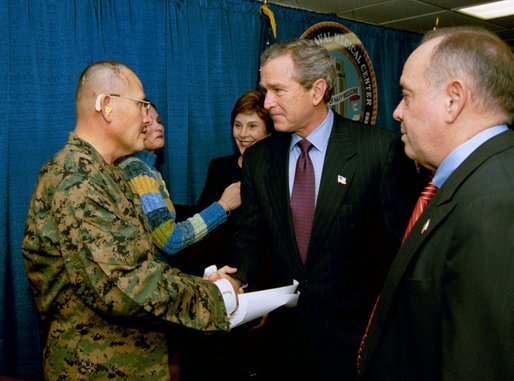
I only read the text, as I just couldn't pull away from Heaven's Gate on my DVR. Regardless of my failure, I wanted to share one comment to Bush's speech, in which he told the tearful tale of Guadalupe Denogean, a Mexican immigrant who, after joining the United States Marine Corps in 1978, finally became a citizen in 2003.

After reading this bit, I stopped to wonder aloud how someone who was admittedly not an American citizen can serve in the country's army for twenty-five plus years. How did Guadalupe Denogean get into the U.S. Army in the first place in 1978? Apparently, the military has only had a "dodge bullets for citizenship" program for immigrant soldiers since the late 1990s.

To make matters doubly confounding was Bush speaking disparagingly of people using "forged documents" to enter the country and obtain employment. Did Denogean use forged documents to enter the military? If not, how exactly was he able to enlist? If he did use forged documents, does that diminish his honorable service? If not, then why is it okay to "cheat" your way into getting wounded in an unjustified war and not to "cheat" your way into obtaining a job? Denogean, now on the other side of the fence (pun intended), says he does not favor amnesty for undocumented immigrants and stated that, "This is the land of opportunity. You can make it what you want... But to do it right, you have to be legal."


Denogean becoming "citizenized." April 11, 2003 (really).


Could it be that this three-year old "rah rah" story is just a feeble minded attempt to link the immigration issue to one of the many issues Bush is taking a beating on in the polls?

Iraq quagmire? Don't worry, we'll have a guest soldier program.

National Security? You bet we're going to address that with the immigration bill. It might have been Mexicans on 9/11... Mexican Al-Qaeda, of course. With WMDs.

Economic problems got you down? Sure, we'll just have a guest worker program , but that doesn't mean employers will have to give 'em minimum wage or government-subsidized health care. Oh, and by the way, corporate exploiters of immigrant labor, you're absolved of any blame because, even though you assiduously checked all those W-2 documents before hiring your labor for a nickel an hour, it's clear that the immigrants are master document forgers. You're clearly not to blame... at all.

In fact, the program has been designed such that you won't have to pay benefits or SSI or FICA taxes for any guest workers. Instead, checks should be made out to your Republican representative(s) just in time for the primaries. You see, it's a win-win. Go team.

Blog Community

Add to Technorati Favorites